Textile Industry
Ensuring precise motion control in weaving, knitting, and spinning machines for enhanced productivity.

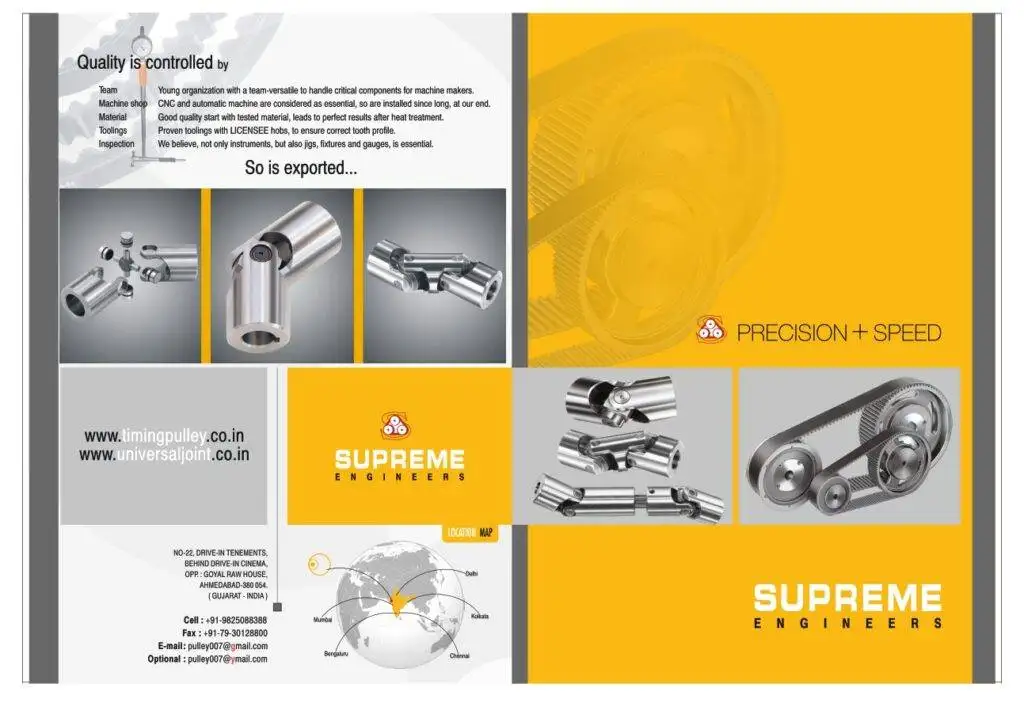
Delivering precision timing pulleys, universal joints, and custom components across textile, cement, pharma, and packaging industries.
Ensuring precise motion control in weaving, knitting, and spinning machines for enhanced productivity.
Supporting machinery involved in processing and shaping rubber, ensuring durability and efficiency.

Providing critical components for pharmaceutical machinery that demands precision and reliability in manufacturing and packaging.
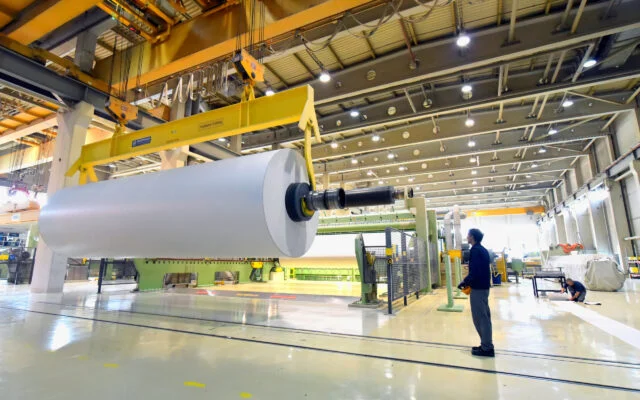
Enabling smooth operation and synchronization in printing presses, which require accurate movement for quality output.

Enhancing automation in packaging machinery to maintain consistency, hygiene, and speed in food processing.
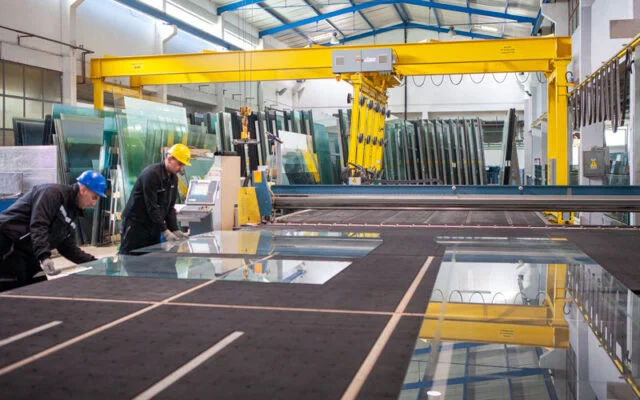
Playing a role in high-temperature processes and handling precision movements for shaping and cutting glass.
Power transmission components move motion and force from a motor to the part of a machine that does the work. Supreme Engineers, an Ahmedabad-based manufacturer with more than 35 years of experience, makes timing pulleys, universal joints, gears, rack and pinion sets, couplings and keyless clampex locking devices for machine builders and plant maintenance teams. The industrial applications of power transmission components are wide, and the notes below explain where each product fits and how to match a component to the job.
Power transmission components carry rotation and force from a drive source, such as an electric motor, to the working parts of a machine. They control speed, torque and direction, absorb misalignment and keep moving parts synchronised. Almost every production line depends on them. A packaging machine uses a toothed belt drive to keep a filling station and a sealing station in step, a conveyor uses couplings and gears to carry torque along its length, and a machine tool uses precision gears and racks to position a table accurately. When a part is poorly matched to its job, the result is vibration, noise, backlash, early wear or unplanned downtime, so the application should guide the component choice rather than the other way round.
Picture a packaging line. A motor drives a gearbox, and a coupling joins the gearbox to the main shaft, absorbing small alignment errors. Timing pulleys and belts carry drive from the main shaft to the filling, sealing and labelling stations so that they move in step. A universal joint connects a drive to a station set at an angle, and keyless locking devices hold hubs on shafts without keyways so that they can be adjusted and removed easily. A conveyor feeding the line uses sprockets, chain and couplings to move product. Every one of these parts has a different job, and a weak link at any point shows up as noise, drift in timing or a stopped line.
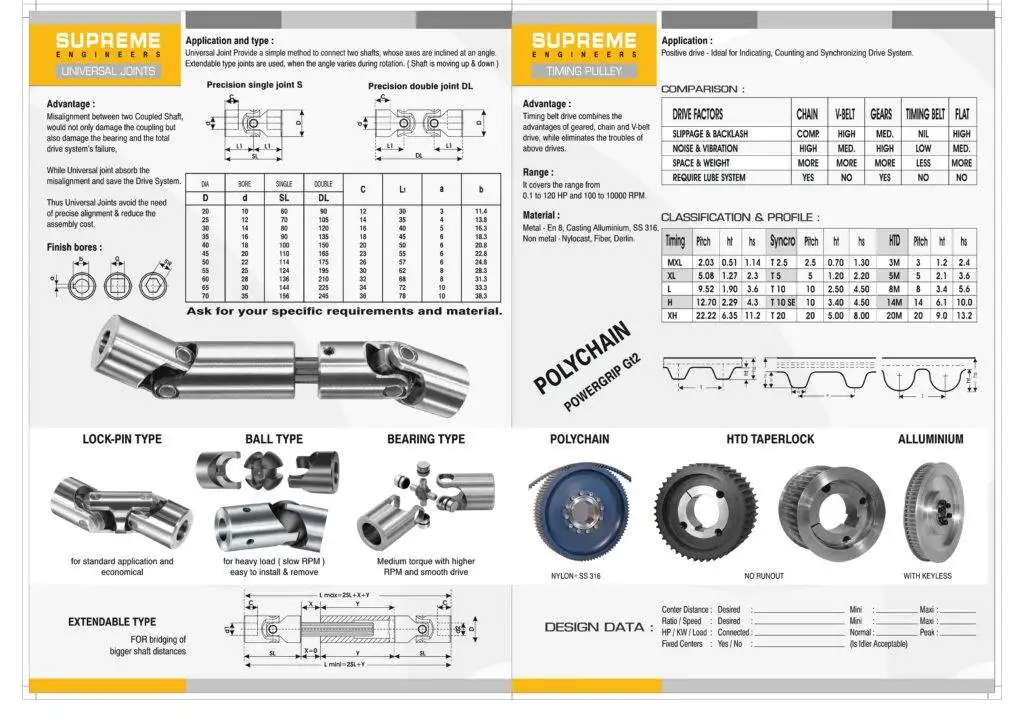
Timing pulleys and belts are used wherever two or more shafts must stay synchronised without slip. Unlike a V-pulley, which relies on friction in a grooved wedge and can slip, a timing pulley has teeth that mesh with a toothed belt, so shafts stay in step and the speed ratio stays exact. The toothed engagement also gives quiet running with little maintenance, which is why timing drives are common in packaging, textile, printing, CNC and automation equipment and in general machinery building.
In packaging and pharmaceutical packaging lines, timing drives index products to the right position at the right moment. In printing machinery they help hold registration between units, in textile machinery they keep rollers and feeding mechanisms moving in a fixed relationship, and in automation axes they turn motor rotation into accurate positioning. Pulleys are specified by tooth profile, such as MXL, XL, L, H, HTD or GT2, and the pulley and belt must share the same profile and pitch. You can browse our timing pulleys and timing belts to see the ranges we manufacture.
Universal joints transmit torque between two shafts that are not in a straight line. They are used in machine tools, packaging and processing equipment, conveyors and printing machinery, wherever shafts must connect at an angle or alignment changes in operation. A single joint suits modest angles, while a double joint copes with larger ones. One point matters in design: a single joint delivers uneven output speed when it runs at an angle, and the effect grows as the angle increases. Two joints arranged in phase with equal angles cancel this out, which is why drive shafts often use a pair.
Joints with needle bearings or bushes generally need periodic lubrication, depending on the design and the duty, while some designs are sealed, so follow the maintenance guidance for the specific joint. Our universal joint applications page shows typical installations, and our selection and maintenance guide explains how to size a joint.
Gears change speed and torque between shafts, rack and pinion sets turn rotation into straight-line motion, and couplings join shafts while absorbing misalignment and shock. Together they appear in conveyors, mixers, pump-driven equipment, cutting machines and material-handling lines, where reliable torque transfer matters most. Rack and pinion drives position gantries, cutting tables and automation carriages along a straight path, while spur and helical gears reduce speed and raise torque in gearboxes and pump drives. Sprockets and industrial chain carry power across conveyors and elevators, and couplings protect motors, gearboxes and pumps from the small alignment errors that every installation has. See our gears and couplings, rack and pinion and industrial chain pages for the full ranges.
A keyless locking device such as Keyless Clampex fixes a hub or pulley to a shaft by friction instead of a keyway. This avoids stress concentration at the keyway, allows fine positional adjustment and makes fitting and removal simple. Because there is no keyway to wear or loosen, keyless connections suit precision drives, reversing loads and assemblies that need regular dismantling, including servo drives and indexing tables where play at the shaft joint would spoil accuracy. See our Keyless Clampex page for details.
Start with the load and speed: the torque to transmit, the shaft speed and the duty cycle. Then check shaft alignment, available space, the operating environment, such as dust, heat or moisture, and how often the part must be serviced. These factors narrow the choice before size and material are fixed. Ask whether the drive needs exact synchronisation, because that points to timing belts and gears rather than friction drives, and whether the shafts are aligned, because misalignment points to couplings or universal joints. Consider shock loads, reversing duty and start-stop frequency, which shorten the life of an undersized part, and think about maintenance access, since a part that is hard to reach should be chosen for long, low-attention service. If you are replacing an existing component, send us the old part or its drawing and we can match it.
Alongside standard pulleys, joints, gears and couplings, we machine custom parts to your drawing or sample using CNC turning, VMC and gear-cutting equipment. Many of the parts we make are not catalogue items at all. They are built around a specific machine, an obsolete design or a particular space limit. Send the drawing or worn part with your quantity and timeline, and our team will review it and reply with a quotation. You can learn more on our custom components page, download our product catalogue to check standard sizes, or use the contact page with your application details.
If your application is not listed here, tell us about the machine and the problem you want to solve. Our team will suggest a suitable component or quote a custom one. Contact Supreme Engineers in Ahmedabad to start the conversation.