Textile Industry
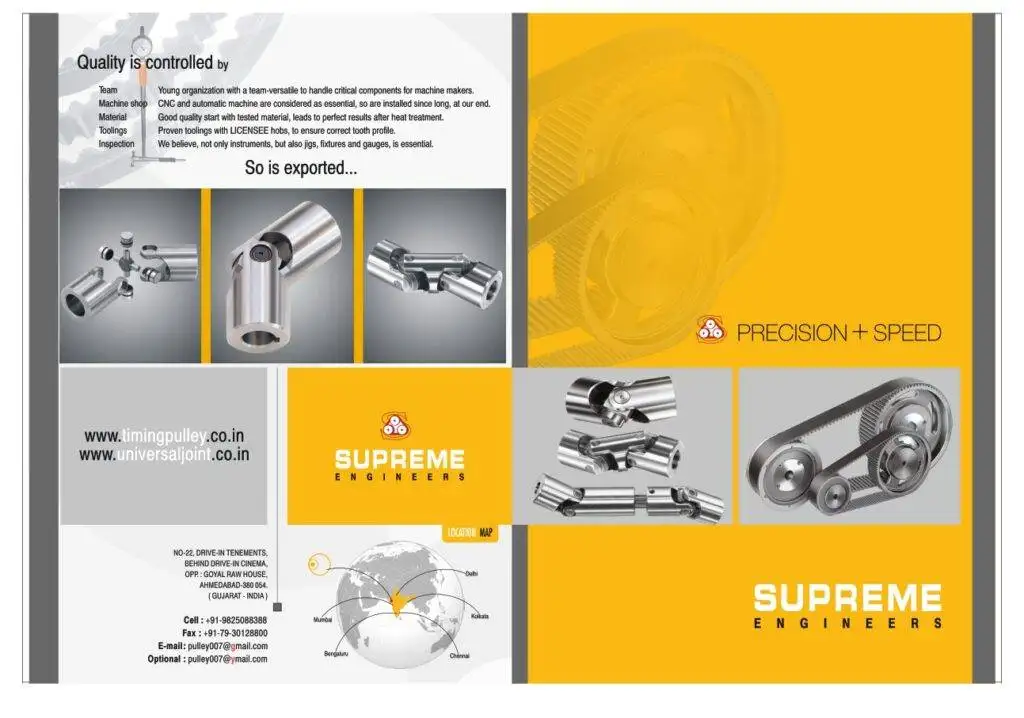
Ensuring precise motion control in weaving, knitting, and spinning machines for enhanced productivity.

Power transmission components move motion and force from a motor to the part of a machine that does the work. Supreme Engineers, an Ahmedabad-based manufacturer, makes timing pulleys, universal joints, gears, rack and pinion sets, couplings and keyless clampex locking devices for machine builders and plant maintenance teams. This page explains the industrial applications of power transmission components, which product suits which job, and how to choose correctly.
Power transmission components carry rotation and force from a drive source, such as an electric motor, to the working parts of a machine. Depending on their design, they control speed, torque and direction, accommodate shaft misalignment, or keep moving parts synchronised. Typical examples are timing pulleys, gears, universal joints, couplings and shaft-locking devices.
Almost every production line depends on them. A packaging machine uses a toothed belt drive to keep a filling station and a sealing station in step. A conveyor uses couplings and gears to carry torque along its length. A machine tool uses precision gears and racks to position a table accurately. When a part is poorly matched to its job, the result is vibration, noise, backlash, early wear or unplanned downtime, so the application should guide the component choice rather than the other way round.
Ensuring precise motion control in weaving, knitting, and spinning machines for enhanced productivity.
Supporting machinery involved in processing and shaping rubber, ensuring durability and efficiency.

Providing critical components for pharmaceutical machinery that demands precision and reliability in manufacturing and packaging.
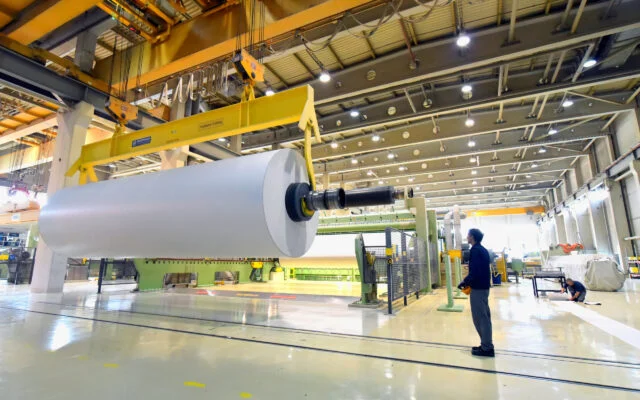
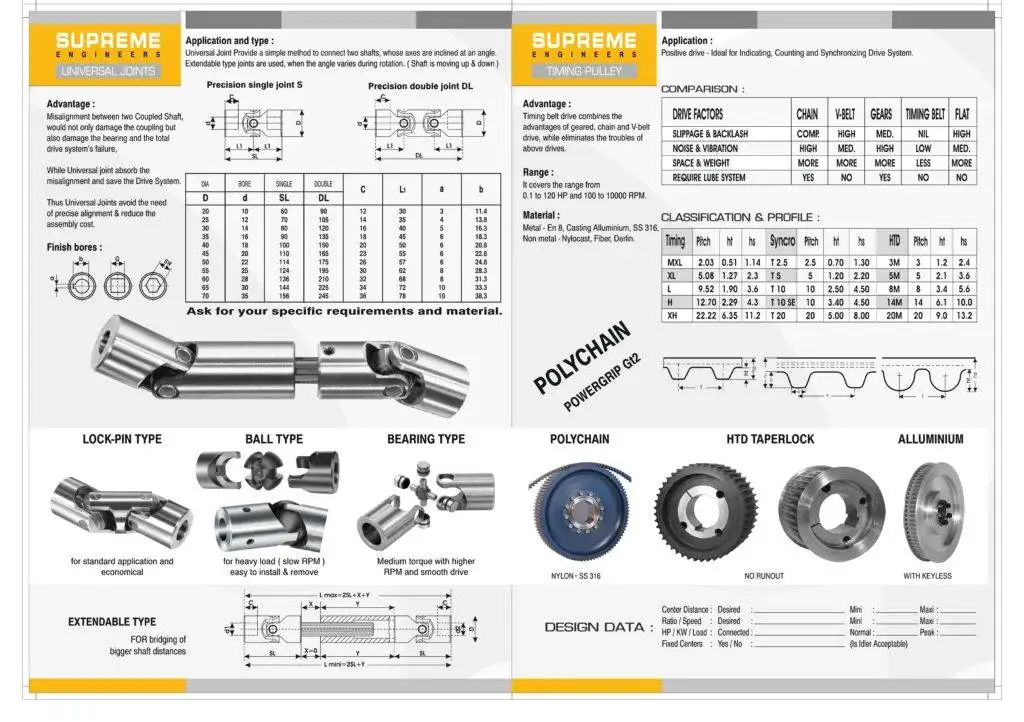
Enabling smooth operation and synchronization in printing presses, which require accurate movement for quality output.

Enhancing automation in packaging machinery to maintain consistency, hygiene, and speed in food processing.
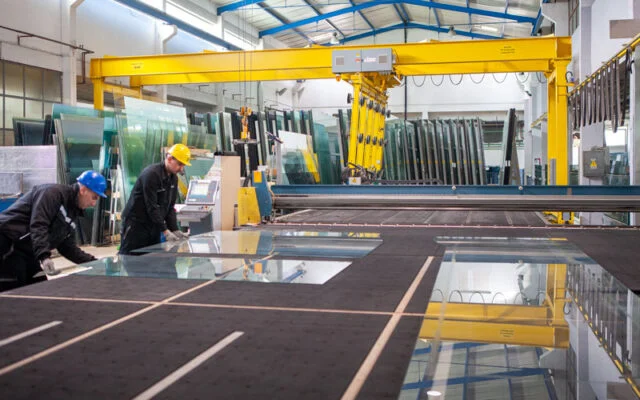
Playing a role in high-temperature processes and handling precision movements for shaping and cutting glass.
Timing pulleys and belts are used wherever two or more shafts must stay synchronised without slip. Common sectors include packaging, textile, printing, CNC and automation equipment, and general machinery building. Their toothed engagement gives positive drive, steady speed ratios and quiet running with little maintenance.
In packaging and pharmaceutical packaging lines, timing drives index products to the right position at the right moment. In printing machinery they help hold registration between units. In textile machinery they keep rollers and feeding mechanisms moving in a fixed relationship. In automation and linear axes they turn motor rotation into accurate positioning. Pulleys are specified by tooth profile, such as MXL, XL, L, H, HTD or GT2, and the pulley and belt must share the same profile and pitch. Browse our timing pulleys and timing belts to see the product ranges.
Universal joints transmit torque between shafts that connect at an angle. Typical applications include machine tools, packaging and processing equipment, conveyors and printing machinery. Choosing a single joint, a double joint or a shaft assembly requires reviewing the shaft layout, operating angle, speed and load against the selected product specification.
Joint selection should account for output-speed variation as well as shaft angle. Ask our team to review the complete shaft arrangement and joint specification for your application. Our universal joint applications page shows typical installations, and our selection and maintenance guide explains the factors to consider when sizing a joint.
Gears change speed and torque between shafts, rack and pinion sets turn rotation into straight-line motion, and couplings connect shafts. The ability of a coupling to accommodate misalignment or cushion shock depends on its design and rating. These components appear in conveyors, mixers, pump-driven equipment, cutting machines and material-handling lines.
Rack and pinion drives position gantries, cutting tables and automation carriages along a straight path. Spur and helical gears are used in gearboxes and other drives. Sprockets and industrial chain carry power across conveyors and elevators. Select couplings for the alignment conditions and loads of the installation. See our gears and couplings, rack and pinion and industrial chain pages for the ranges.
A keyless locking device such as Keyless Clampex fixes a hub or pulley to a shaft by friction instead of a keyway. This avoids stress concentration at the keyway, allows fine positional adjustment and makes fitting and removal simple. It suits precision drives, reversing loads and assemblies that need regular dismantling. See our Keyless Clampex page for details.
Start with the load and speed: the torque to transmit, the shaft speed and the duty cycle. Then check shaft alignment, available space, the operating environment, such as dust, heat or moisture, and how often the part must be serviced. These factors narrow the choice before size and material are fixed.
Ask whether the drive needs exact synchronisation, because that points to timing belts and gears rather than friction drives. Review the shaft arrangement when considering couplings or universal joints. Consider shock loads, reversing duty and start-stop frequency when specifying the part. Finally, think about maintenance access. If you are replacing an existing component, send us its drawing or details so our team can review the requirement.
We review custom-part enquiries alongside our standard product ranges. Send the drawing or sample details with your material, critical dimensions, quantity and timeline. Our team can assess the required machining operations and confirm feasibility, lead time and quotation for your requirement.
Many of the parts we make are not catalogue items at all. They are built around a specific machine, an obsolete design or a particular space limit. Learn more on our custom components page.
A timing pulley has teeth that mesh with a toothed belt, so there is no slip and shafts stay synchronised. A V-pulley relies on friction in a grooved wedge, which is simpler and cheaper but can slip. Choose a timing drive where position or speed ratio must stay exact.
Many do. Joints with needle bearings or bushes generally need periodic lubrication, depending on the design and duty, while some designs are sealed. Follow the maintenance guidance for the specific joint and its operating conditions.
Use the contact page or enquiry button with your application details, drawing and quantity. You can also download our product catalogue first to check standard sizes.
If your application is not listed here, tell us about the machine and the problem you want to solve. Our team will suggest a suitable component or quote a custom one. Contact Supreme Engineers in Ahmedabad to start the conversation.